1. Sliding Window
 [
[

When to use it?
- Linear data structures (arrays, lists, strings)
- Must scan through a subarray or substring
- When the subarray must satisfy some condition (shortest/longest/min/max)
- Improve time complexity from O(N^2) to O(N)
Technique
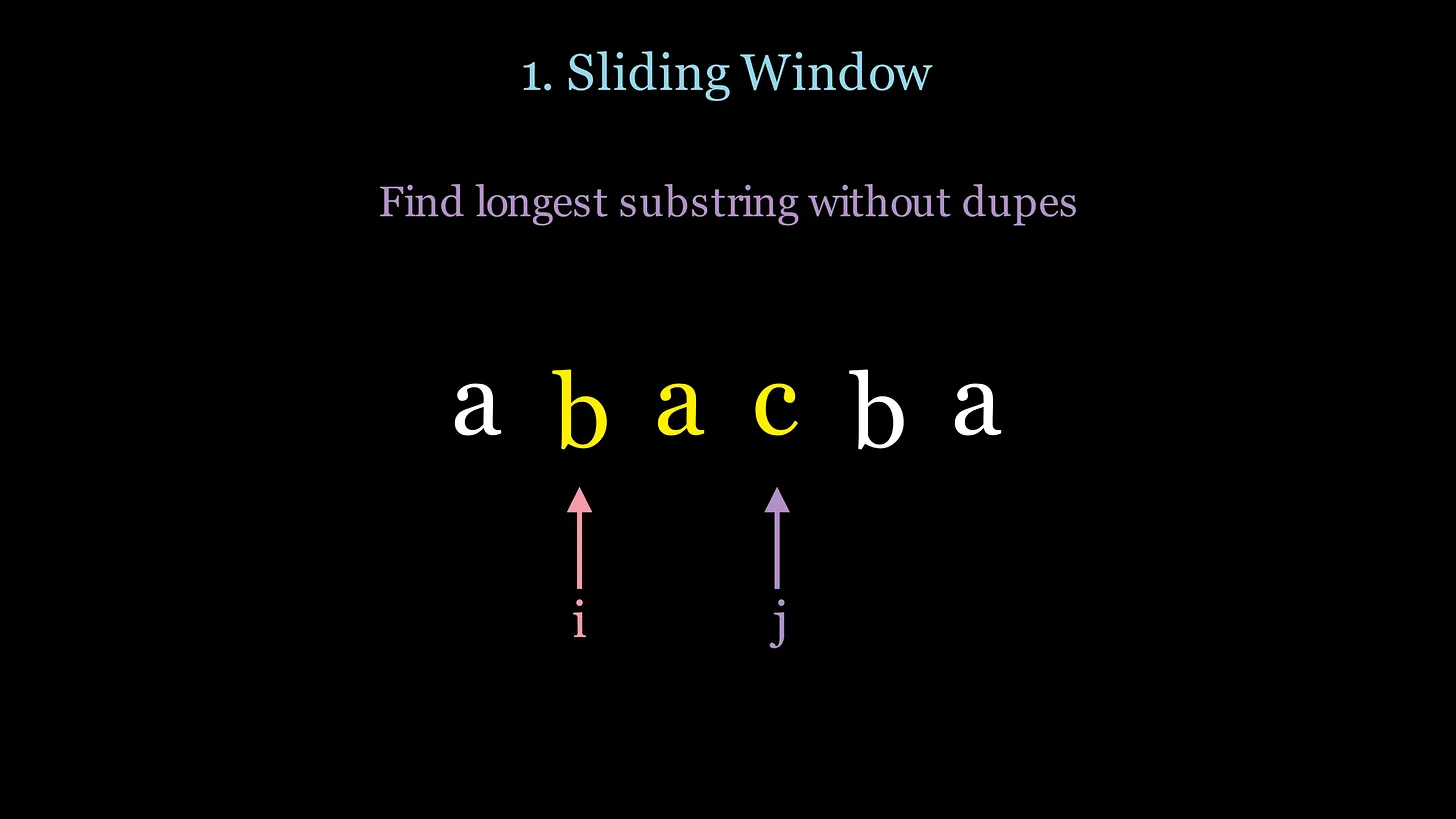
In the sliding window, you have 2 pointers, i and j. Move j as far as you can until your condition is no longer valid, then move the i pointer closer to j until the condition is valid again to shrink the window. At every iteration, keep track of the min/max length of the subarray for the result. Without the sliding window technique, we would need to use a double for loop resulting in O(N^2) time. The sliding window is O(N) time complexity.
Dynamic Sliding Window
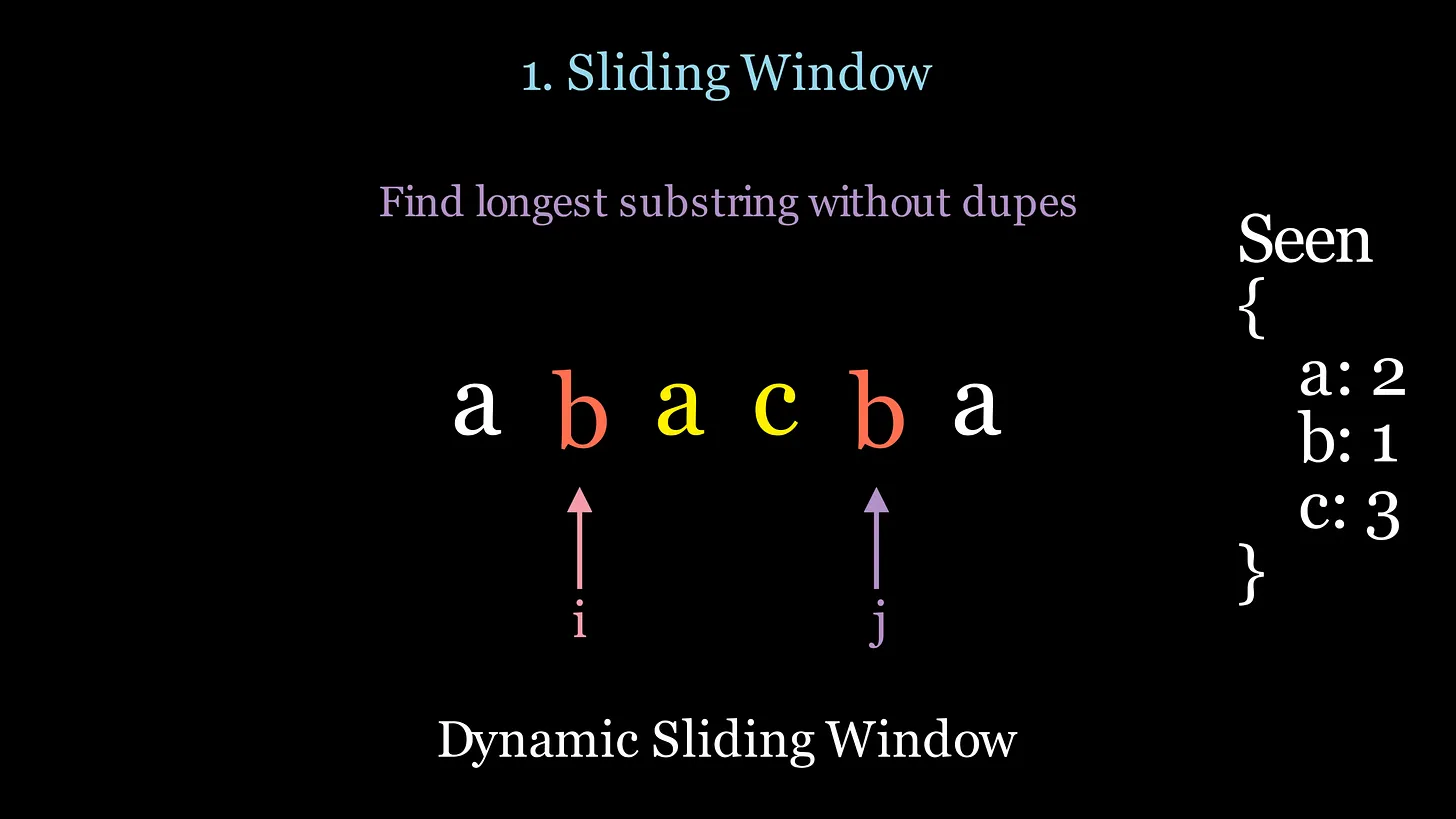
In the dynamic sliding window, the size of the window (subarray between i and j) changes throughout the algorithm. In this example, we scan the subarray “bacb” and find that we have a duplicate “b”, so we will move the i pointer to shrink the window and move on to letter “a”, resulting in “acb”, then we start moving j again.
Fixed Sliding Window
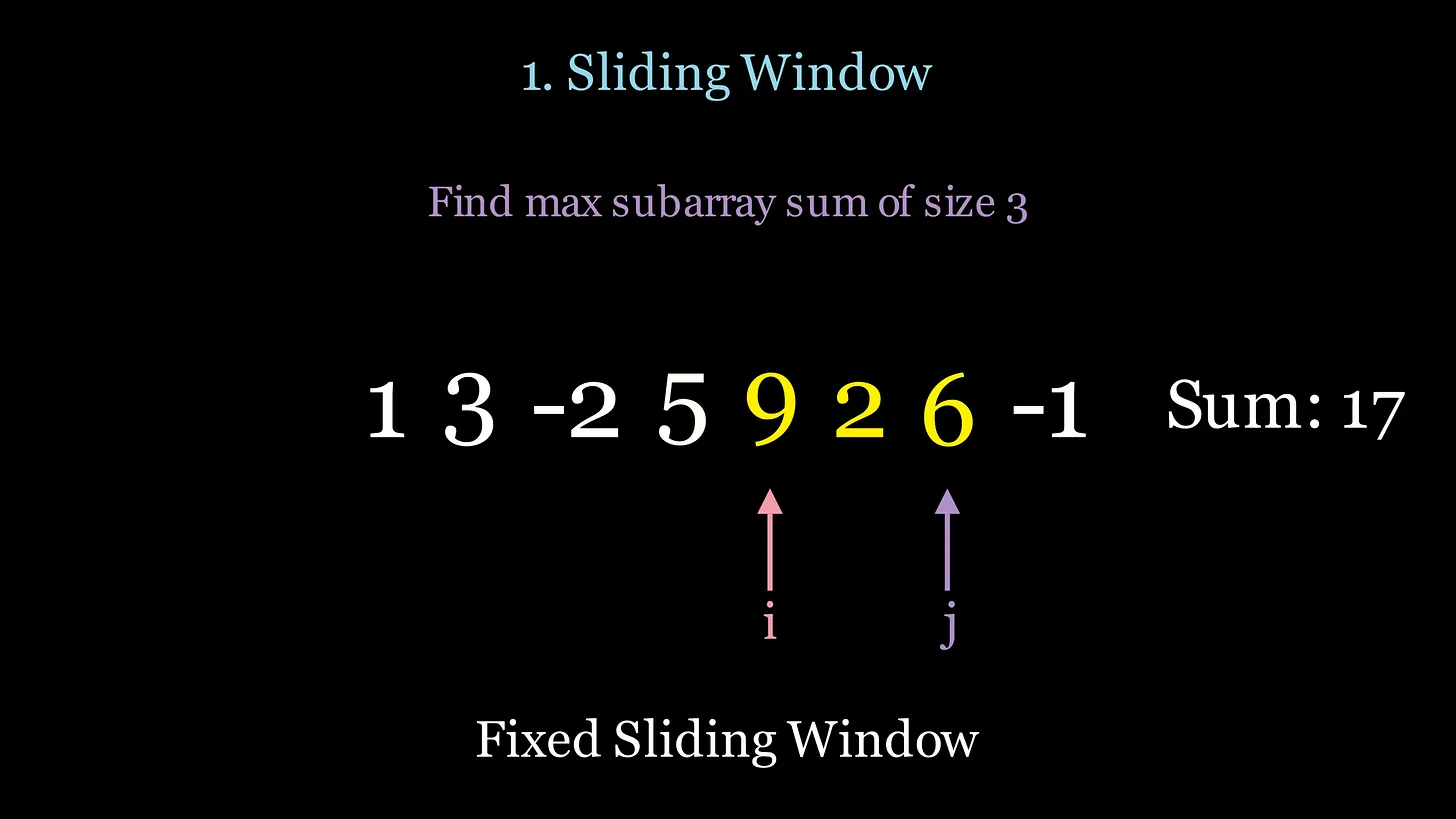 In the fixed sliding window, the size of the window is the same length throughout the algorithm. In this case, we need scan subarrays of length 3 for the final result, so we initialize i and j to indices 0 and 2 and at every iteration we increment i and j by 1.
"""
A generic template for dynamic sliding window finding min window length
"""
def shortest_window(nums, condition):
    i = 0
    min_length = float('inf')
    result = None

    for j in range(len(nums)):
        # Expand the window
        # Add nums[j] to the current window logic

        # Shrink window as long as the condition is met
        while condition():
            # Update the result if the current window is smaller
            if j - i + 1 < min_length:
                min_length = j - i + 1
                # Add business logic to update result

            # Shrink the window from the left
            # Remove nums[i] from the current window logic
            i += 1

    return result
"""
A generic template for dynamic sliding window finding max window length
"""
def longest_window(nums, condition):
    i = 0
    max_length = 0
    result = None

    for j in range(len(nums)):
        # Expand the window
        # Add nums[j] to the current window logic

        # Shrink the window if the condition is violated
        while not condition():
            # Shrink the window from the left
            # Remove nums[i] from the current window logic
            i += 1

        # Update the result if the current window is larger
        if j - i + 1 > max_length:
            max_length = j - i + 1
            # Add business logic to update result

    return result
"""
A generic template for sliding window of fixed size
"""
def window_fixed_size(nums, k):
i = 0
result = None
for j in range(len(nums)):
# Expand the window
# Add nums[j] to the current window logic
# Ensure window has size of K
if (j - i + 1) < k:
continue
# Update Result
# Remove nums[i] from window
# increment i to maintain fixed window size of length k
i += 1
return resultLeetCode Questions
- 3. Longest Substring Without Repeating Characters
- 424. Longest Repeating Character Replacement
- 1876. Substrings of Size Three with Distinct Characters
- 76. Minimum Window Substring