Course: Computer Networks
Subject: Computer_network
Date: 11-06-2025
Topic: osi
Introduction
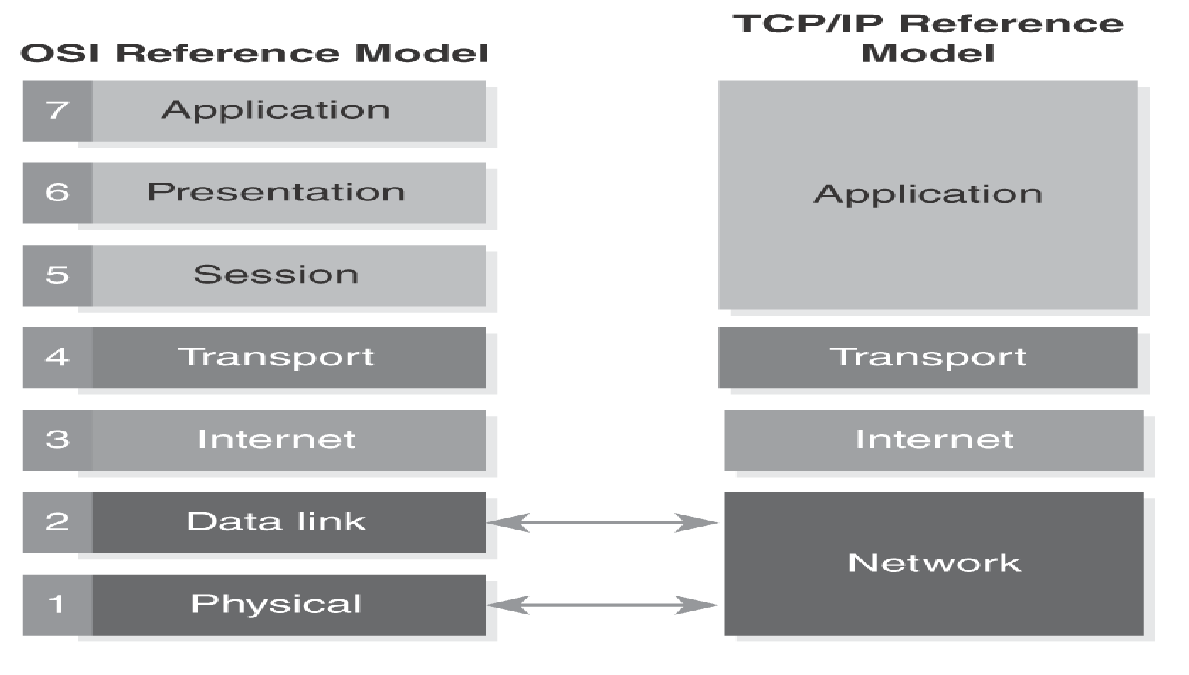
- The OSI model has 7 layers, while the TCP/IP model has 4 layers.
- The top three layers of the OSI model (Application, presentation, session) correspond to the Application layer in the TCP/IP model. Drawing 2025-06-11 08.45.46.excalidraw
Session layer (OSI layer 5)
key functions
- controls conversation between computers
- manages connection setup, maintenance and termination
- organizes individual packets into coherent conversations
Communication methods
- Full-duplex: simultaneous two way communication (e.g telephones)
- Half-duplex: Alternating two way communication (e.g walkie-talkies)
- Simplex: one way communication only
Important Session Layer Protocols
- H.245: Call control for multimedia communication
- L2TP: Tunneling protocol for VPNs (operates at Layer 5 despite name)(layer 2 tunneling protocol)
- NetBIOS: Enables LAN communication and file sharing(network basic input/output system)
- RPC: Allows executing procedures on remote computers(Remote procedural call)
- SMB: Provides shared access to files, printers, and ports(server message block)
- SOCKS: Proxy protocol for bypassing firewalls (often uses port 1080)
Presentation Layer (OSI Layer 6)
Key Responsibilities
- Data Translation:
- Converts between different encoding systems (e.g., ASCII to EBCDIC)
- Ensures interoperability between different computer systems
- Handles file format standards (TIFF, GIF, JPEG, MPEG, MIDI)
- Encryption/Decryption:
- Secures sensitive information during transmission
- Primarily encrypts Application Layer data
- Compression:
- Reduces data size for efficient transmission
- Especially important for multimedia content
Presentation Layer Protocols
- IMAP: Email retrieval protocol (keeps emails on server)(internet message access protocol)
- SSH: Secure remote command execution and shell access(secure shell)
- SSL/TLS: Cryptographic protocols for secure connections(secure socket layer)(transport layer security)
Application Layer (OSI Layer 7)
Key Characteristics
- Direct interface with users or application processes
- Highest layer in both OSI and TCP/IP models
- Where application software interacts with network services
Network Architectures
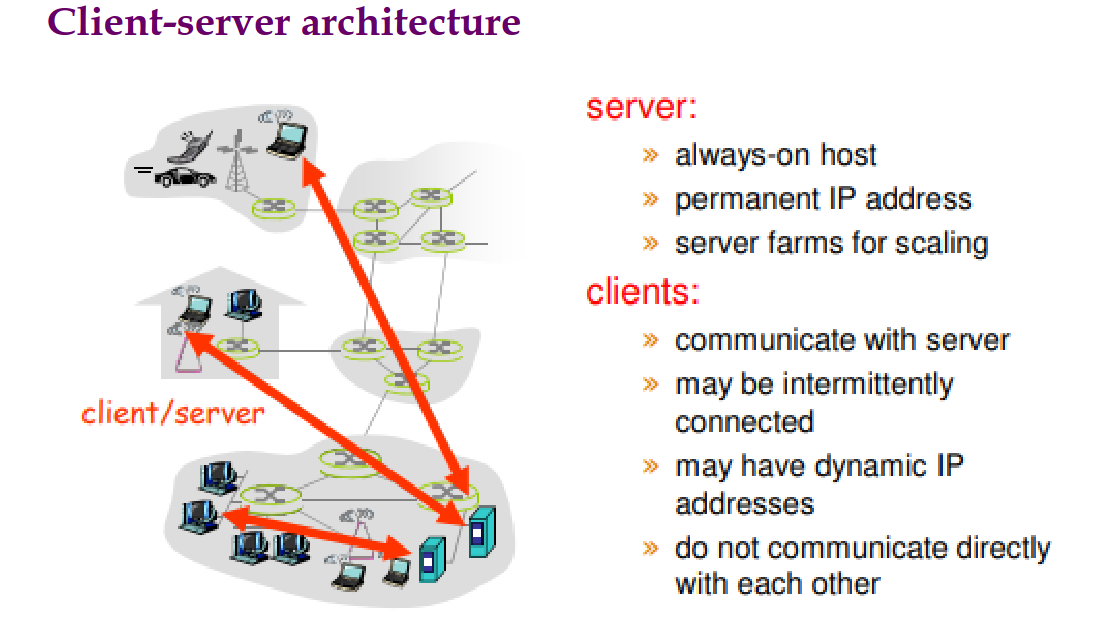
- Client-Server:
- Dedicated servers with permanent IP addresses
- Clients connect intermittently, may have dynamic IPs
- Clients don’t communicate directly with each other
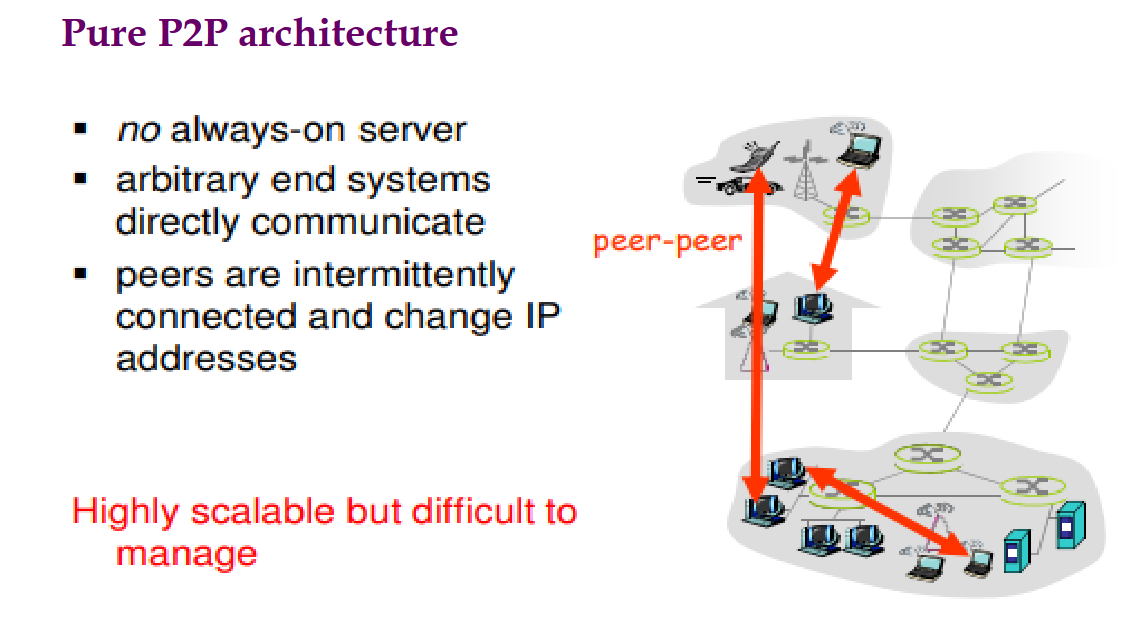
- Peer-to-Peer (P2P):
- No central servers
- All peers can act as both clients and servers
- Highly scalable but harder to manage
Process Communication
- Processes identified by IP address + port number
- Common port examples: HTTP (80), SMTP (25)
- Client process initiates communication
- Server process waits for contact requests
Transport Service Requirements
Applications need different transport services based on:
- Data loss tolerance (e.g., audio vs. file transfer)
- Timing requirements (e.g., VoIP or online games need low delay)
- Throughput needs (e.g., multimedia vs. elastic apps)
- Security needs (encryption, data integrity)
- TCP:
- Connection-oriented
- Reliable with flow and congestion control
- No timing or throughput guarantees
Transport Protocol Options
- UDP:
- Connectionless
- Unreliable but faster
- No control mechanisms
Major Application Layer Protocols
- DNS (domain name system)
- Translates domain names to IP addresses
- Hierarchical structure (.com, .edu, .net domains)
- HTTPS:(hypertext transfer protocol)(hypertext transfer protocol secure)
- Web page delivery protocol
- Uses HTML for content markup
- HTTPS adds security layer
- FTP: (file transfer protocol)
- File transfer protocol
- Uses port 21 for control, port 20 for data
- Built into most OSes and browsers
- Email Protocols:
- SMTP: Sending mail between servers (simple mail transfer protocol)
- POP3: Download-and-delete email access (post office protocol 3)
- IMAP: Server-based email management (internet message access protocol)
- Other Important Protocols:
- DHCP: Automatic IP address assignment
- NFS: Distributed file sharing system (network file system)
- RTP: Streaming media protocol (real-time transfer protocol)
- SNMP: Network management protocol (simple network management protocol)
- Telnet: Remote terminal protocol (insecure)
Important Distinction
- OSI Application Layer ≠ end-user applications
- Provides services that applications use (e.g., browser uses HTTP)
- Some applications may use network services transparently (e.g., word processor accessing network file)
Transport Layer (OSI Layer 4)
Introduction to Transport Layer
- Position in OSI Model: 4th layer (between Network and Session layers)
- Key Responsibility: Process-to-process delivery of complete messages (vs network layer’s packet-by-packet delivery)
- Core Functions:
- Multiplexing multiple applications on single devices
- Ensuring reliable, in-order data delivery
- Implementing error handling mechanisms
Key Concepts
Delivery Types Comparison
- Node-to-node: Handled by Data Link Layer (Layer 2)
- Host-to-host: Handled by Network Layer (Layer 3)
- Process-to-process: Handled by Transport Layer (Layer 4)
Transport Layer Responsibilities
- Service-point Addressing:
- Uses port numbers to identify specific processes
- While network layer delivers to host, transport layer delivers to correct application
- Segmentation and Reassembly:
- Divides messages into transmittable segments
- Uses sequence numbers for proper reassembly
- Handles lost packet retransmission
- Flow Control:
- End-to-end control (vs Data Link Layer’s single-link control)
- Prevents sender from overwhelming receiver
- Error Control:
- Process-to-process error checking
- Ensures complete message arrives without errors
- Uses acknowledgments and retransmissions
- Connection Control:
- Connectionless (independent segments) vs Connection-oriented (established connection)
Addressing and Ports
Port Number System
- Purpose: Identify specific processes on a host
- Range: 16-bit integers (0-65,535)
- Types:
- Well-known ports: 0-1023 (assigned by IANA)
- Examples: FTP (21), SSH (22), SMTP (25), HTTP (80)
- Registered ports: 1024-49,151 (can be registered)
- Dynamic/Ephemeral ports: 49,152-65,535 (temporary client ports)
- Well-known ports: 0-1023 (assigned by IANA)
Socket Address
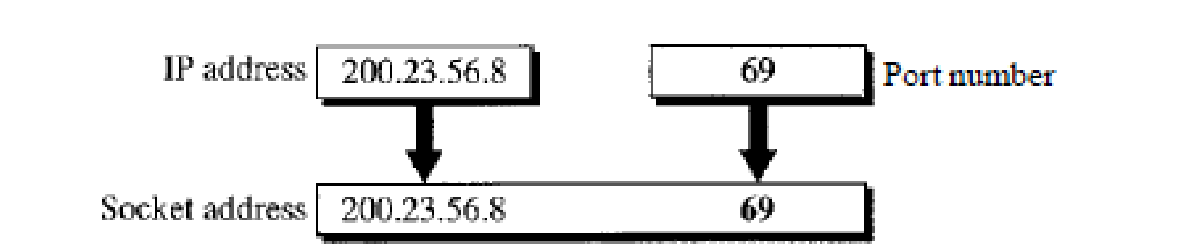
- Combination of IP address and port number
- Uniquely identifies both ends of communication
- Example: 200.23.56.8:69
Transport Layer Protocols
1. User Datagram Protocol (UDP)
- Characteristics:
- Connectionless
- Unreliable (no guarantees)
- Minimal overhead (8-byte header)
- No flow/error/connection control
- Header Fields:
- Source port (16 bits)
- Destination port (16 bits)
- Length (16 bits)
- Checksum (16 bits)
- Use Cases:
- Simple request-response applications
- Processes with built-in error control (e.g., TFTP)
- Multicasting
- Management processes (SNMP)
- Routing protocols (RIP)
2. Transmission Control Protocol (TCP)
- Characteristics:
- Connection-oriented (3-way handshake)
- Reliable delivery
- Stream-oriented (vs message-oriented)
- Full-duplex communication
- Implements flow and error control
- Key Features:
- Buffering: Uses send/receive buffers to handle speed mismatches
- Segmentation: Groups bytes into segments for IP transmission
- Sequence Numbers: Tracks every byte transmitted
- Acknowledgments: Uses cumulative ACKs (ACK number = next expected byte)
- Connection Management:
- Establishment: 3-way handshake 1. SYN (client → server) 2. SYN-ACK (server → client) 3. ACK (client → server)
- Termination: 4-way handshake (FIN/FIN-ACK sequence)
- Segment Structure:
- Sequence number (first byte in segment)
- Acknowledgment number (next expected byte)
- Control flags (SYN, ACK, FIN, PSH, RST, URG)
- Window size (for flow control)
Comparison of UDP and TCP
| Feature | UDP | TCP |
|---|---|---|
| Connection | Connectionless | Connection-oriented |
| Reliability | Unreliable | Reliable |
| Flow Control | None | Implemented |
| Error Control | Minimal checksum | Extensive (ACKs, retransmissions) |
| Data Organization | Message-oriented | Stream-oriented |
| Overhead | Low (8-byte header) | Higher (20-byte header + control) |
| Speed | Faster | Slower |
| Use Cases | DNS, SNMP, VoIP, multicasting | HTTP, FTP, email, file transfer |
Related
- DSA MOC — Algorithms power network protocols
- Django MOC — HTTP request/response uses these layers
- HTTP Request — HTTP operates at Application layer
- Wireless Communication and Mobile Computing — Wireless networks use these protocols
- Fundamentals and Applications of Mobile Computing — Mobile networking infrastructure